🧰 Case-Based Discussions (CbDs) & Care Assessment Tools (CATs)
Case-Based Discussions (CbDs) and Care Assessment Tools (CATs) are essential parts of your GP training portfolio.
This article explains what each one is, how they’re different, what the requirements are for each stage of training, and how to complete them on FourteenFish.
🧠 CbD vs CAT - What are they? What’s the Difference?
CbDs and CATs are mandatory learning assessments that must be completed during GP training. Both are designed to help you demonstrate clinical reasoning, decision-making, and reflect on patient care.
✅ Case-Based Discussion (CbD) - a sub-type of CAT required in ST1/ST2
A reflective discussion with your supervisor about a real patient case you managed
Explores your clinical reasoning, problem solving, and decision-making
Based on a case you select from a previous surgery or clinical session, and then discuss with your supervisor or a senior colleague.
Used throughout all stages of GP training (ST1–ST3) - you must complete 4 CbDs in ST1 and 4 in ST2
✅ Care Assessment Tool (CAT) - ST3 only
A broader category of learning assessments
Used in ST3 only
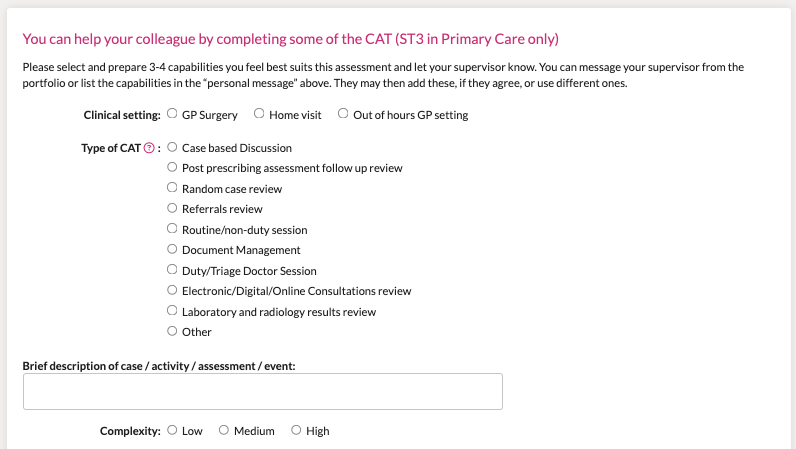
CbD is one type of CAT — but others you can complete in ST3 include:
Post-prescribing reviews
Document management reviews
Duty / triage session reviews
Referral reviews
Online / eConsult case reviews
Lab or imaging result follow-ups
Random case reviews
Routine surgery reviews (non-duty sessions)
Designed to give feedback on everyday clinical work in general practice
Offers more flexibility than traditional CbDs
📋 Training Requirements
In ST1 and ST2, you need to complete 4 Case-Based Discussions (CbDs) each year.
CATs are for ST3 only.
In ST3, you need to complete 5 CATs across the year.
You can include CbDs as part of your ST3 CATs - but you should also aim to include other types, like a random case review or triage session.
Note: In ST3, you can still complete CbDs — but you can also choose to complete other CATs.
✍️ How to Do a CbD or CAT on FourteenFish
The process for submitting a Case-Based Discussion (CbD) or Care Assessment Tool (CAT) is relatively straight forward
🖱️ Step-by-step
Go to the Portfolio tab and click into the Educational Assessments section.
Click CbDs & CATs
Click ‘Request an assessment’, selecting the correct ticket (CbD or CAT)
Fill out the case details
Add a short title (e.g. “Iron deficiency anaemia in young woman”)
Include the date and brief case description — what happened, how you managed it, and why it’s worth discussing.
Send it to your supervisor
Choose a supervisor from your placement (usually your GP trainer or clinical supervisor)
Once sent, they'll receive a notification to review it.
Prior to meeting your supervisor, FourteenFish suggests preparing 3-4 capabilities demonstrated by the assessment for review by your supervisor.
Supervisor completes the assessment
💡 Practical Tips
Be organised - aim for one CbD/CAT every 2-months to avoid a last minute scramble!
Be specific - pick cases that reflect your clinical decision-making (not just simple ones) and demonstrate capabilities that you need to demonstrate (which capability has the most white circles remaining?)
Reflect - the best learning comes from trickier cases
Leadership CAT - for ST3, make sure at least one CAT demonstrates leadership (e.g. team coordination, practice improvement, patient safety)
📎 Next Up
Download the full portfolio checklist to track all your ST1–ST3 requirements: 📥 Download the Revise GP Portfolio Checklist Tool [COMING SOON]