

Your FourteenFish portfolio isn’t just a dumping ground for learning logs - it’s designed to demonstrate that you’re becoming a capable, safe, and competent GP.
One of the key ways it does this is by tracking your evidence against two things:
This article breaks down what these are, why they matter, and how to map them correctly in your portfolio.
These are the core skills and professional attributes that define what it means to be a GP. You’ll need to demonstrate them consistently across your training, with evidence gathered from clinical case reviews, CBDs, COTs, reflections, and more.
Here’s the full list:
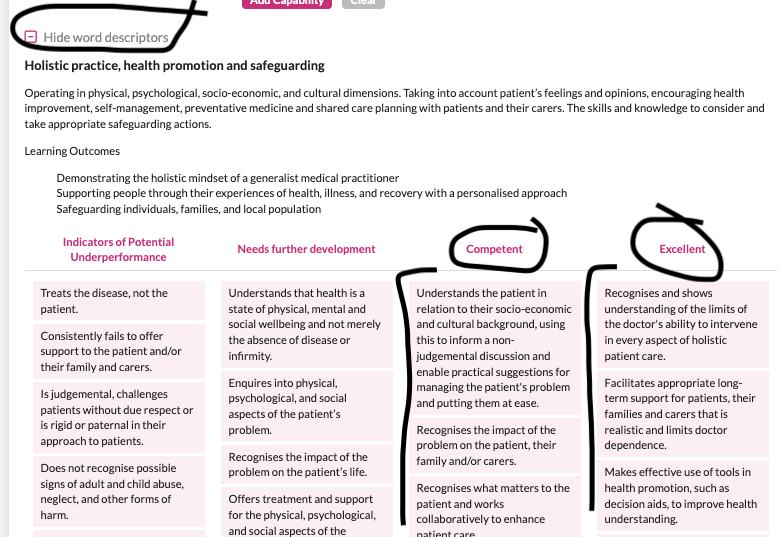
When writing a piece of evidence and selecting a Capability, click “Show word descriptors” just below it. This reveals examples of what each capability looks like at four levels:
Try to mirror their language and include key points in your justification section. For example, if you’re mapping “Working with colleagues and in teams,” and the descriptor talks about multidisciplinary care planning — reflect on how you worked with a district nurse, pharmacist, or social prescriber, and what that added to the care.
This does two things:
These reflect the types of patients and presentations you should encounter as a GP registrar. Each Clinical Case Review (CCR) or log entry should be linked to the most relevant group(s):
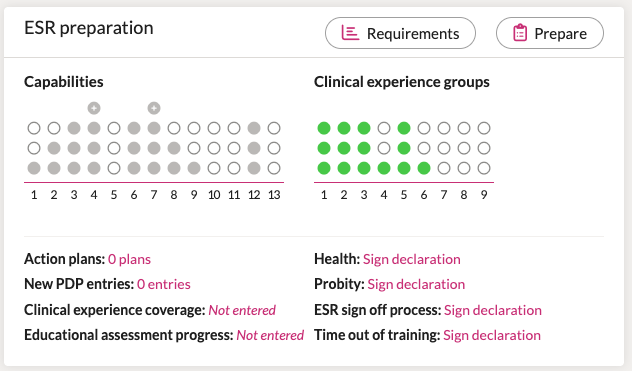
When you log into your portfolio homepage, you’ll see two diagrams filled with small white circles — one for Capabilities, and one for CEGs.
Each circle represents a piece of mapped evidence. As you link more CCRs, assessments, and reflections to the appropriate categories, those white circles turn green/grey.
The goal is to build up enough green circles across all 13 Capabilities and all 9 CEGs to demonstrate broad, well-rounded development.
This matters particularly at ESR time — if your mapping is weak or patchy, your supervisor may not be able to sign you off.
When you write a CCR (or log other evidence such as a CBD/COT/CEX), you’ll be asked to:
You don’t need to cover everything in one log — but across the year, you want a balanced spread.
Every CCR, CBD, COT, and log entry should be mapped to at least one Capability and one CEG. Try to do this as you go — don’t leave it all to the last minute before your ESR.
And remember:
Your ESR (Educational Supervisor Review) relies on a clear, balanced spread of mapped evidence. The green circles help your supervisor — and the ARCP panel — see that you’ve covered all the core competencies and clinical experiences needed to progress.
So:
Once you get into the rhythm, it’s easy.
Ready to write a Clinical Case Review?
Check out our full step-by-step guide:
📝 Clinical Case Reviews: What, How & How Many?